When removing the high pressure fuel pump, high pressure fuel
pipe, delivery pipe, and injector, injury may be caused by leakage of
high pressure fuel. For this reason, do not attempt any repairing
immediately after engine stops.
[Bank 1]
1.
Release the residual pressure in fuel line.
(Refer to the Fuel Delivery System - Repair Procedures - "Release Residual Pressure in Fuel Line")
2.
Turn the ignition switch OFF and disconnect the battery negative (-) terminal.
3.
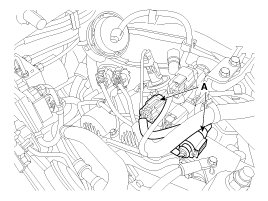
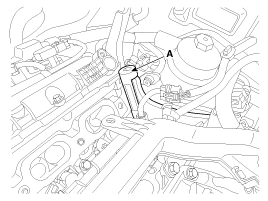
Disconnect the injector & rail pressure sensor extension connector (A).
4.
Remove the intake manifold.
(Refer to Engine Mechanical System - "Intake Manifold")
5.
Remove the high pressure fuel pipe.
(Remove the Fuel Delivery System - "Fuel Line")
6.
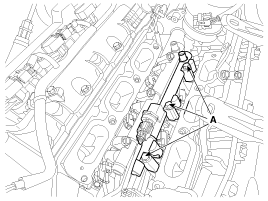
Remove the mounting bolts (A), and then remove the delivery pipe & injector assembly [Bank 2] from the engine.
Do not use already used injector fixing clip again.
•
Install the component to the specified torques.
•
Note that internal damage may occur when the component is dropped. In this case, use it after inspecting.
•
Apply engine oil to the injector O-ring.
•
Do not use already used injector O-ring again.
•
Do not use already used bolt again.
•
When insert the injector, be careful not to damage the injector tip.
•
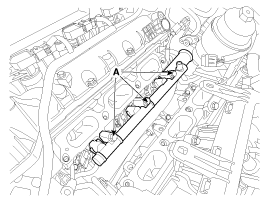
When installing the high pressure fuel pipe and cross over
pipe, apply the specified tightening torques with the special service
tool (A). [SST No. 09314-3V100]
Removal
1.
Open the fuel filler door and then remove the filler-neck mounting bolts (A).
Filler-neck assembly mounting bolt:
7.8 ~ 11.8 N.m (0.8 ~ 1.2 kgf.m, 5.8 ~ 8.7 lb-ft)
2.
Left the ...
Inspection
Visually check the fuel lines for cracks, leakage, loose connections, deformation or tank band looseness.Removal
High pressure fuel pipe (High pressure fuel pipe ↔ Delivery pipe)
...
Other Information:
Cooling System Repair procedures
Inspection
Radiator hoses
1.
Check radiator hoses for the following
(1)
Improper attachment
(2)
Leaks
(3)
Cracks
(4)
Damage
(5)
Loose connections
(6)
Chafing
(7)
Deterio ...
Wheel alignment and tire balance
The wheels on your vehicle were aligned and balanced carefully at the factory
to give you the longest tire life and best overall performance.
In most cases, you will not need to have your wheels al ...
 Kia Sedona: Delivery Pipe Repair procedures


 Filler-Neck Assembly Repair procedures
 Fuel Line Repair procedures
