
 Kia Sedona: CVVT Oil Temperature Sensor (OTS) Description and Operation
Third generation YP (2014-2026) / Kia Sedona YP Service Manual / Engine Control / Fuel System / Engine Control System / CVVT Oil Temperature Sensor (OTS) Description and Operation
| Description |
Continuous Variable Valve Timing (CVVT) system advances or
retards the valve timing of the intake and exhaust valve in accordance
with the ECM control signal which is calculated by the engine speed and
load.
By controlling CVVT, the valve over-lap or under-lap occurs,
which makes better fuel economy, reduces exhaust gases (NOx, HC) and
improves engine performance through reduction of pumping loss, internal
EGR effect, improvement of combustion stability, improvement of
volumetric efficiency, and increase of expansion work.
This system consists of:
- the CVVT Oil Control Valve (OCV) which supplies the engine
oil to the cam phaser or cuts the engine oil from the cam phaser in
accordance with the ECM PWM (Pulse With Modulation) control signal,
- the CVVT Oil Temperature Sensor (OTS) which measures the engine oil temperature,
- and the Cam Phaser which varies the cam phase by using the hydraulic force of the engine oil.
The engine oil released from the CVVT oil control valve
varies the cam phase in the direction (Intake Advance/Exhaust Retard) or
opposite direction (Intake Retard/Exhaust Advance) of the engine
rotation by rotating the rotor connected with the camshaft inside the
cam phaser.
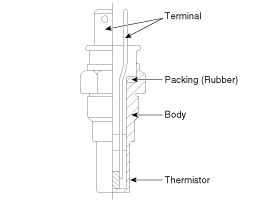
 CVVT Oil Temperature Sensor (OTS) Specifications
Specification
TemperatureResistance (kΩ)Output Voltage (V) [Ref=5V]°C°F-40-4052.154.82-20-416.524.38 ~ 4.530326.03.7520682.452.60 ~ 2.91401041.111.78601400.541.06801760.290.58 ~ 0.691002120.1 ...
 CVVT Oil Temperature Sensor (OTS) Schematic Diagrams
Circuit Diagram
...
Other Information:
Vapor Hose and Fuel Filler Cap Repair procedures
Inspection
Vapor hose
1.
Check all the clamps for tightness and the connections for leakage.
2.
Visually check the vapor lines and hoses for cracks, leaks, loose connections, or deformation.
...
Automatic reversal
If an object or part of the body is detected while the sunroof is closing automatically,
it will reverse direction, and then stop.
The auto reverse function does not work if a tiny obstacle is be ...
Categories
- Home
- First Generation
- Second Generation
- Third generation
- Kia Sedona YP 2014-2026 Owners Manual
- Kia Sedona YP 2014-2026 Service Manual

Copyright © www.kisedona.com 2016-2026