
 Kia Sedona: Engine Coolant Temperature Sensor (ECTS) Description and Operation
Third generation YP (2014-2026) / Kia Sedona YP Service Manual / Engine Control / Fuel System / Engine Control System / Engine Coolant Temperature Sensor (ECTS) Description and Operation
| Description |
Located in the engine coolant passage of the cylinder, the
Engine Coolant Temperature Sensor (ECTS) is used to detect the engine
coolant temperature. The ECTS uses a thermistor whose resistance changes
with the temperature.
The electrical resistance of the ECTS decreases as the
temperature increases, and increases as the temperature decreases. The
reference +5V is supplied to the ECTS via a resistor in the ECM. That
is, the resistor in the ECM and the thermistor in the ECTS are connected
in series. When the resistance value of the thermistor in the ECTS
changes according to the engine coolant temperature, the output voltage
also changes.
During cold engine operation, the ECM increases the fuel
injection duration and controls the ignition timing using the
information of engine coolant temperature to avoid engine stalling and
improve drivability.
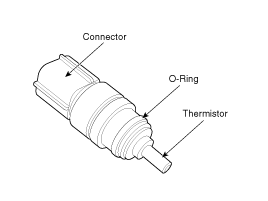
 Engine Coolant Temperature Sensor (ECTS) Specifications
Specification
TemperatureResistance (kΩ)°C°F-40-4048.14-20-414.13 ~ 16.830325.7920682.31 ~ 2.59401041.15601400.59801760.32
...
 Engine Coolant Temperature Sensor (ECTS) Schematic Diagrams
Circuit Diagram
...
Other Information:
If the engine overheats
If your temperature gauge indicates overheating, you experience a loss of power,
or hear loud pinging or knocking, the engine will probably be too hot. If this happens,
you should:
1.Pull off the ...
Parking Brake Cable Repair procedures
Removal
Parking brake pedal Type
1.
Turn ignition switch OFF and disconnect the negative (-) battery cable.
2.
Remove the crash pad lower panel.
(Refer to Body - "Crash pad lower panel")
...
Categories
- Home
- First Generation
- Second Generation
- Third generation
- Kia Sedona YP 2014-2026 Owners Manual
- Kia Sedona YP 2014-2026 Service Manual

Copyright © www.kisedona.com 2016-2026