
 Kia Sedona: CVVT Oil Control Valve (OCV) Description and Operation
Third generation YP (2014-2026) / Kia Sedona YP Service Manual / Engine Control / Fuel System / Engine Control System / CVVT Oil Control Valve (OCV) Description and Operation
| Description |
Continuous Variable Valve Timing (CVVT) system advances or
retards the valve timing of the intake and exhaust valve in accordance
with the ECM control signal which is calculated by the engine speed and
load.
By controlling CVVT, the valve over-lap or under-lap occurs,
which makes better fuel economy, reduces exhaust gases (NOx, HC) and
improves engine performance through reduction of pumping loss, internal
EGR effect, improvement of combustion stability, improvement of
volumetric efficiency, and increase of expansion work.
This system consists of:
- the CVVT Oil Control Valve (OCV) which supplies the engine
oil to the cam phaser or runs out the engine oil from the cam phaser in
accordance with the ECM PWM (Pulse With Modulation) control signal,
- the CVVT Oil Temperature Sensor (OTS) which measures the engine oil temperature,
- and the Cam Phaser which varies the cam phase by using the hydraulic force of the engine oil.
The engine oil released from the CVVT oil control valve
varies the cam phase in the direction (Intake Advance/Exhaust Retard) or
opposite direction (Intake Retard/Exhaust Advance) of the engine
rotation by rotating the rotor connected with the camshaft inside the
cam phaser.
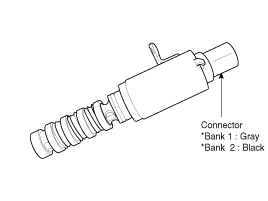
 CVVT Oil Control Valve (OCV) Specifications
Specification
ItemSpecificationCoil Resistance (Ω)9.4 ~ 10.4 [20°C(68°F)]
...
 CVVT Oil Control Valve (OCV) Schematic Diagrams
Circuit Diagram
...
Other Information:
Front Seat Belt Buckle Repair procedures
Replacement
1.
Remove the front seat assembly.
(Refer to Front Seat - "Front Seat Assembly")
2.
Disconnect the front seat belt buckle connector wiring (A).
3.
After loosening the mounting ...
Fuel requirements
Your new vehicle is designed to use only unleaded fuel having a pump octane number
((R+M)/2) of 87 (Research Octane Number 91) or higher. (Do not use methanol blended
fuels.)
Your new vehicle is ...
Categories
- Home
- First Generation
- Second Generation
- Third generation
- Kia Sedona YP 2014-2026 Owners Manual
- Kia Sedona YP 2014-2026 Service Manual

Copyright © www.kisedona.com 2016-2026